Technical Insights
Exploring advanced computing technologies and their impact on enterprise systems and manufacturing

GPU Computing: Transforming Modern Infrastructure and Manufacturing
Graphics Processing Units (GPUs) have evolved from specialized hardware designed solely for rendering images and visual effects into powerful parallel computing engines that drive nearly every sector of modern computing, from gaming and artificial intelligence (AI) to scientific research and advanced manufacturing.
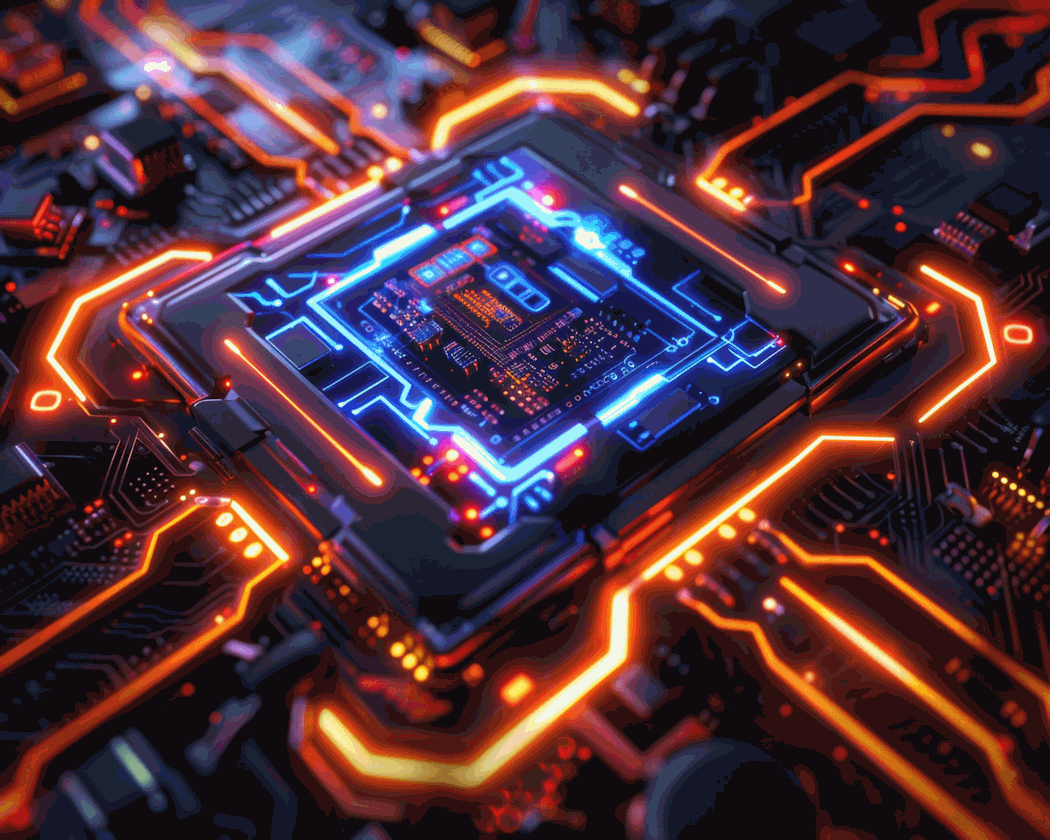
Parallel Computing Architecture
In the realm of parallel computing, GPUs provide the computational horsepower necessary to execute billions of arithmetic operations per second, leveraging architectures built around CUDA (Compute Unified Device Architecture) from NVIDIA, ROCm from AMD, and OpenCL as open standards for heterogeneous computing. Unlike CPUs, which typically consist of fewer, general-purpose cores optimized for sequential task execution, GPUs are comprised of thousands of smaller cores designed for concurrent operations.
This structure allows them to excel in workloads that can be decomposed into smaller, parallel tasks, such as matrix multiplications, vector processing, and convolutional neural network (CNN) operations used in AI and deep learning. Training a large AI model with millions of parameters on a CPU could take weeks, whereas GPU acceleration can reduce that time to hours or even minutes.

GPUs in Advanced Manufacturing
The role of GPUs in advanced manufacturing is transformative, particularly as industries adopt digital twins, simulation-driven design, robotics, and AI-powered quality control systems. Manufacturing environments now rely on real-time data analytics, simulation, and automation, all of which demand immense computational capacity.
GPUs power computer-aided design (CAD) and computer-aided engineering (CAE) software, enabling engineers to simulate stresses, heat dissipation, and material behaviors under complex conditions with unprecedented accuracy. The use of Finite Element Analysis (FEA) and Computational Fluid Dynamics (CFD) in product design benefits immensely from GPU acceleration, reducing computation times by orders of magnitude.

Industrial Automation and Robotics
In industrial automation and robotics, GPUs serve as the computational backbone for machine vision, motion planning, and predictive maintenance. Robotic arms equipped with cameras and sensors use GPU-powered neural networks to recognize components, classify defects, and adjust assembly paths dynamically. Real-time image processing on the factory floor demands millisecond-level inference speeds—achievable only through GPU acceleration.
GPUs are also crucial for digital twin technologies, which create virtual replicas of physical assets to simulate performance and detect anomalies before they occur in the real world. This capability enhances predictive maintenance and operational efficiency by allowing manufacturers to anticipate failures or inefficiencies in machinery, thus minimizing downtime.

Edge Computing and IIoT Integration
The integration of GPUs with edge computing and Industrial Internet of Things (IIoT) platforms further enhances manufacturing intelligence. Edge-based GPU systems can analyze sensor data locally, reducing latency and bandwidth consumption while enabling real-time decision-making. This is particularly beneficial for automated quality control, where visual inspection algorithms detect microscopic flaws faster than human operators.
Combining GPUs with AI frameworks allows factories to implement reinforcement learning models that continuously improve production parameters based on sensor feedback. These systems contribute to lower energy consumption, higher resource utilization, and enhanced supply chain resilience.

Heterogeneous Computing
GPUs play a critical role in the ongoing transition toward heterogeneous computing, where CPUs, GPUs, and specialized accelerators collaborate within unified architectures. This multi-processor synergy is key for industries that require diverse computational tasks to occur simultaneously. Cloud providers offer GPU-based virtual machines tailored for rendering, machine learning, and HPC workloads, democratizing GPU access for enterprises of all sizes.
The software ecosystem supporting GPU computing includes libraries like cuDNN for neural networks, cuFFT for fast Fourier transforms, and cuBLAS for matrix algebra. Frameworks such as TensorFlow, PyTorch, and JAX abstract GPU operations, allowing developers to harness parallelism without delving into low-level programming.
Conclusion
Graphics Processing Units represent one of the most transformative innovations in modern computing. From their origins in rendering polygons for video games to their current role powering AI-driven manufacturing and scientific research, GPUs exemplify how architectural specialization can redefine computational efficiency. Their parallel processing capabilities enable accelerated workloads across data-intensive industries, while their integration into manufacturing pipelines fosters innovation, speed, and operational intelligence.
Related Technologies
Exploring the broader ecosystem of advanced computing

High-Performance Computing
Leveraging parallel processing architectures for complex simulations and data-intensive workloads

Cloud Computing
Scalable infrastructure solutions enabling distributed computing and on-demand resources

Edge Computing
Processing data closer to the source for reduced latency and real-time decision-making